
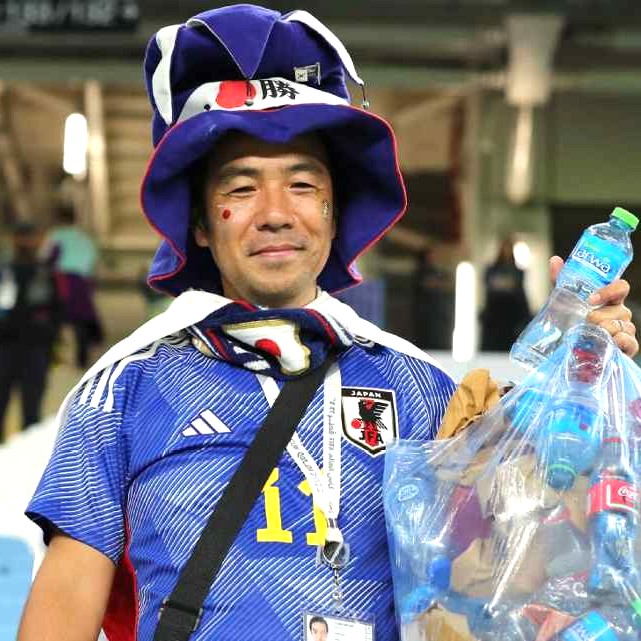
Have you ever seen the stands of a major sports stadium after the game is over? Water bottles, soda cups, and half-eaten food left under the seats. Napkins and paper strewn everywhere. Beer trickling out of cans that were kicked over as people leave in a hurry.
Most of us step over that mess on our way out. But Japanese soccer fans and World Cup players are showing the rest of us up in a big way.
WHAT THEY DO
Win or lose, after a big game – soccer or otherwise – Japanese fans interrupt their own revelry and get to work. Using their own blue plastic bags, they go up and down every row, picking up trash until it’s gone. It’s a messy, time-consuming job, and no one asks them to do it.
Likewise, Japanese players leave the locker room in exceptional condition. They discard their trash, fold and stack their towels neatly, and often leave a message of thanks in the local language to show gratitude for the use of the space.
But why?
LEARNING THE MINDSET
The behavior is rooted in the Japanese proverb tatsu tori ato o nigosazu – translated as “a bird leaves nothing behind” – meaning leave a space the way you found it. It’s a mindset. Japanese kids are taught from a young age to be responsible for cleaning up collective spaces like school classrooms and hallways, often without being told.
“It’s respect. We’re honored to be here,” said one Japanese fan after her country tied the Netherlands in its 2026 World Cup opener in Texas on June 14. “We don’t want to make a mess and then leave it.”
They did it again after their win against Tunisia in Monterrey, Mexico this week.
THE SCOUTING MODEL
In certain pockets of our society, we teach our kids to do it, too. My three kids were all Scouts; two made it to Eagle rank. While they were expected to pick up their rooms and clean up around the house, it wasn’t until they got into Scouting that they learned to “leave no trace.”
When Scouts go into the woods to camp or hike, they learn quickly to bring out everything they brought in and leave everything they find in nature for those who come after them to enjoy. Over time, it becomes so ingrained that they just do it without thinking.
WHAT ABOUT THE REST OF US
The good news? Even those who aren’t raised in Japan or Scouting can do it, too. Practicing respect for others and your surroundings is a habit anyone can cultivate.
It starts with paying attention. Take an extra few seconds to think about what you’re about to do and how it might affect the next person. Put your trash in a can instead of leaving it by the bench in the park. Don’t pick flowers from a public place; the beautiful bouquet that could sit on your counter means others passing through the park are denied the joy of seeing those same flowers out in nature.
Put your dishes in the dishwasher instead of leaving them in the sink for the next family member to deal with (parents, am I right?). Move your shoes (or wet towel, or backpack) out of the main walking path in your house so others don’t have to step over them to get out the door.
Walk your trash to the bin you’ll pass at the movie theater exit instead of leaving it under your chair. Take up only the space you need in the breakroom fridge at work so others have room to store their lunches as well.
Once you start thinking this way, you’ll see opportunities everywhere.
SOMEONE ELSE WILL DO IT
A final point: just because it’s someone else’s job doesn’t mean you can’t help make their life easier. They’ll still have plenty to do after you leave.
Former Penn State football player and current Baltimore Raven Olaivavega “Vega” Ioane demonstrated this can-do spirit last fall when he jumped a barrier to help a struggling equipment manager push a heavy cart up a ramp while being heckled by opposing fans after a devastating loss to Ohio State. It wasn’t the lineman’s job, and no one expected it of him. The fact that he did it anyway speaks to his true character.
The collective mindset might take a little extra thought or time, but flipping the narrative can make it feel less like a burden.
What if it’s your teenage kid cleaning up the stadium after the big game or the movie theater after the late show? Less trash to pick up gets them home faster (and you to bed sooner!).
Or maybe you’re the one hiking a trail or walking through a public space. You’ll appreciate it being clean and filled with beautiful flowers if others have acted responsibly before you arrived.
Everyday Americans are showing up in other ways for our World Cup guests, but we could all learn a thing or two about the collective mindset from the Japanese fans and players.
Because the real lesson isn’t about trash bags, locker rooms, or stadium seats. It’s about what we leave behind when we walk away. Every space we enter – public or private, shared or personal – is affected by the choices we make in it. We can leave more work for the next person, or we can leave a little more order, beauty, and consideration than we found.
So the next time you’re tempted to step over the mess, pause. What “messes” – literally and figuratively – are you leaving in your wake? And what would change if you took care of them yourself instead of waiting for someone else to clean them up?
Please share this post with your people and remember that YOU MATTER! We each have a part in making this world a better place. Let’s do this!
(Photo/Getty)
